Understanding Anti-Nutrients in Raw Grains
Unprocessed cereal grains and legumes contain naturally occurring anti-nutritive compounds, primarily phytic acid (myo-inositol 1,2,3,4,5,6-hexakisphosphate). Phytic acid tightly chelates essential divalent cations such as Fe²⁺, Zn²⁺, Ca²⁺, and Mg²⁺, forming insoluble complexes that human digestive enzymes cannot easily break down.
The Phytate-Mineral Chelation Mechanism
Phytic acid possesses six phosphate groups capable of binding strongly to positive mineral ions. In raw un-germinated grains, up to 80% of total phosphorus is bound in phytates, severely reducing elemental mineral bio-availability in developing infants.
Controlled Enzymatic Malting & Phytase Activation
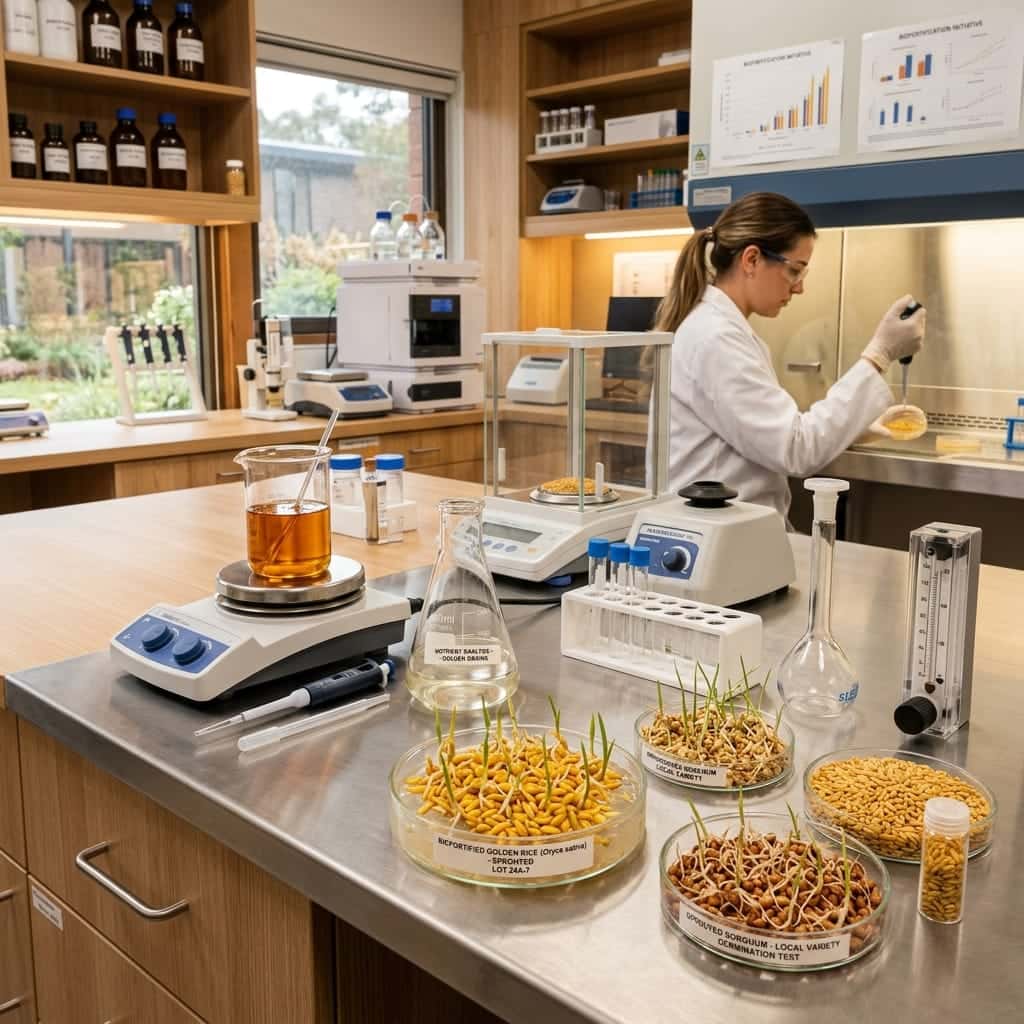
At RYMS Food, our formulation process leverages natural enzymatic degradation through controlled germination (malting):
- Hydration & Imbibition: Seeds absorb water, triggering endogenous phytase enzyme activation.
- Hydrolysis: Phytase systematically cleaves phosphate groups from the inositol ring, releasing free bioavailable minerals (Fe²⁺ and Zn²⁺).
- Starch Pre-Digestion: Alpha- and beta-amylases break down long-chain amylose and amylopectin starches into dextrins, reducing viscosity so infants can consume energy-dense food without excess water dilution.
Comparative Mineral Bioavailability
| Process | Phytate Reduction (%) | Iron Absorption Rate (%) | Viscosity (cP at 65°C) |
|---|---|---|---|
| Raw Grain Flour | 5% - 10% | ~ 2.5% | High (~ 4500 cP) |
| Soaked Only | 20% - 35% | ~ 4.2% | Medium (~ 3200 cP) |
| Germinated & Malted (RYMS) | 85% - 95% | ~ 14.8% | Optimal (~ 800 cP) |
Conclusion
By combining clinical biochemistry principles with traditional African food processing techniques, RYMS formulates food that nourishes infants at the cellular level with maximum safety and efficiency.